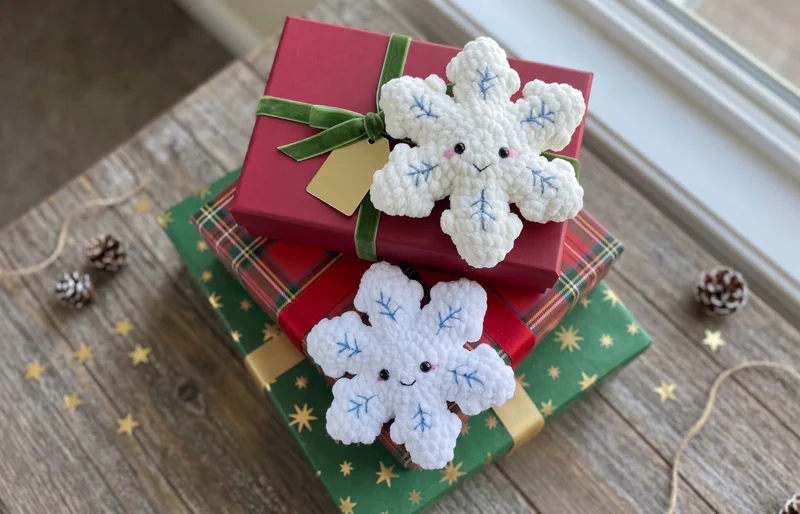
This cheerful snowflake sits somewhere between Christmas ornament and small plush character. Six rounded points, embroidered blue branches, rosy cheeks, and a softly stuffed centre give the familiar winter shape a friendly amigurumi personality.
This is an independent editorial guide to the No-Sew Crochet Snowflake Pattern by RNata on Etsy. We have not purchased or tested the instructions. The paid PDF—not this article—contains the pattern, stitch counts, and step-by-step photographs.
Before buying: this listing is for one English-language PDF delivered digitally. It does not include a finished snowflake, yarn, a hook, or a printed booklet.
The pattern at a glance
| Detail | What the Etsy listing says |
|---|---|
| Project | Plush Christmas snowflake |
| Construction | No-sew; the points are made as one connected piece rather than stitched on individually |
| Finished height | Approximately 16–17 cm (about 6.3–6.7 in) |
| File | One instantly downloadable PDF |
| Language | English only |
| Main yarn | Plush yarn; the sample uses YarnArt Dolce |
| Hook | 4.5–5 mm |
| Face | 9 mm safety eyes plus embroidered details |
These details were checked on September 26, 2026. A digital listing can be updated, so use the live Etsy page for the current file, price, policies, and support information.
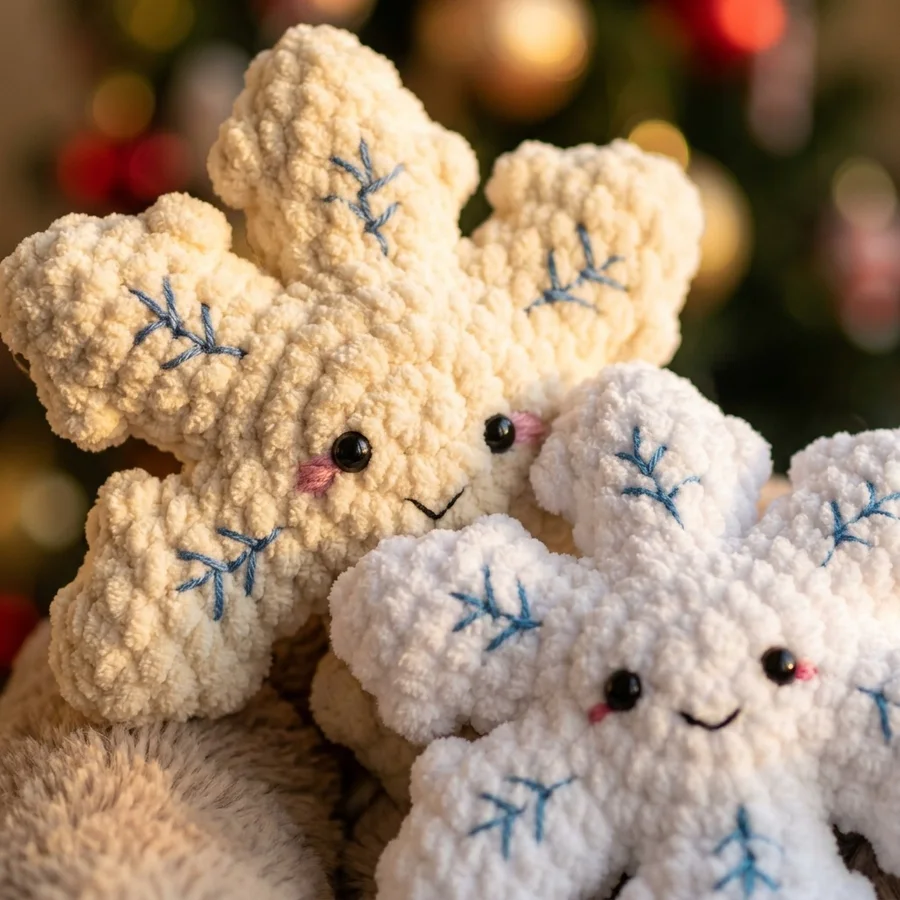
The raised plush stitches and embroidered branches give each snowflake a soft, dimensional finish. Photo supplied for this article; pattern design by RNata.
What “no-sew” means here
The main attraction is the connected construction. RNata describes the six snowflake points as being crocheted into one piece, so makers do not have to create six separate arms and sew each one to a centre. That can remove one of the slowest and least predictable parts of small amigurumi: aligning repeated pieces evenly.
No-sew does not mean that the entire project is needle-free. The listing still calls for a yarn needle, black embroidery yarn, and stuffing. The face, blue branch lines, and yarn ends need finishing, while the safety eyes must be placed at the stage specified in the PDF. Read the complete pattern before starting so none of those details are added too late.
No-sew also does not automatically mean beginner-level. Plush yarn can hide the tops of stitches, and six matching points reward accurate counting. A maker who is comfortable working in the round, increasing and decreasing, marking the start of a round, and handling stuffing will have the easiest time.
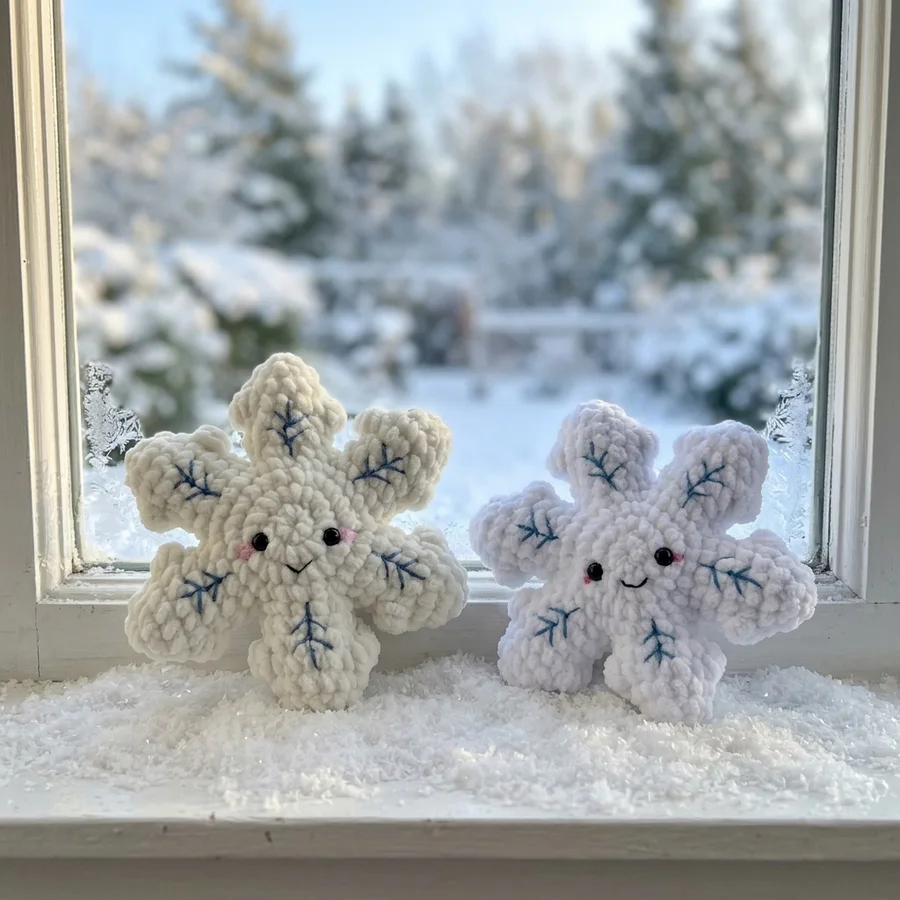
The cream and bright-white versions show how a small colour change can shift the mood from warm and cosy to crisp and wintry. Photo supplied for this article; pattern design by RNata.
Materials to gather
The public listing names a 4.5–5 mm crochet hook, plush yarn, 9 mm safety eyes, stuffing, a yarn needle, embroidery yarn, and a stitch marker. RNata’s photographed examples use YarnArt Dolce in white colour 741 and old lace colour 745, with Scheepjes Catona listed for embroidered details.
Treat those product names and hook sizes as the designer’s sample information, not a promise that every substitute will behave the same way. Plush yarns can differ in thickness, stretch, sheen, and how easily their fibres shed. A different yarn may change the finished 16–17 cm size and can make the points softer or firmer.
Before substituting, compare the yarn weight and metres per ball with the requirements inside the purchased PDF. Make a small test section if you are new to the yarn. If the fabric has visible gaps after stuffing, try the adjustment recommended by the designer rather than simply pulling every stitch tighter; excessive tension can make plush yarn difficult to work and can distort the snowflake.
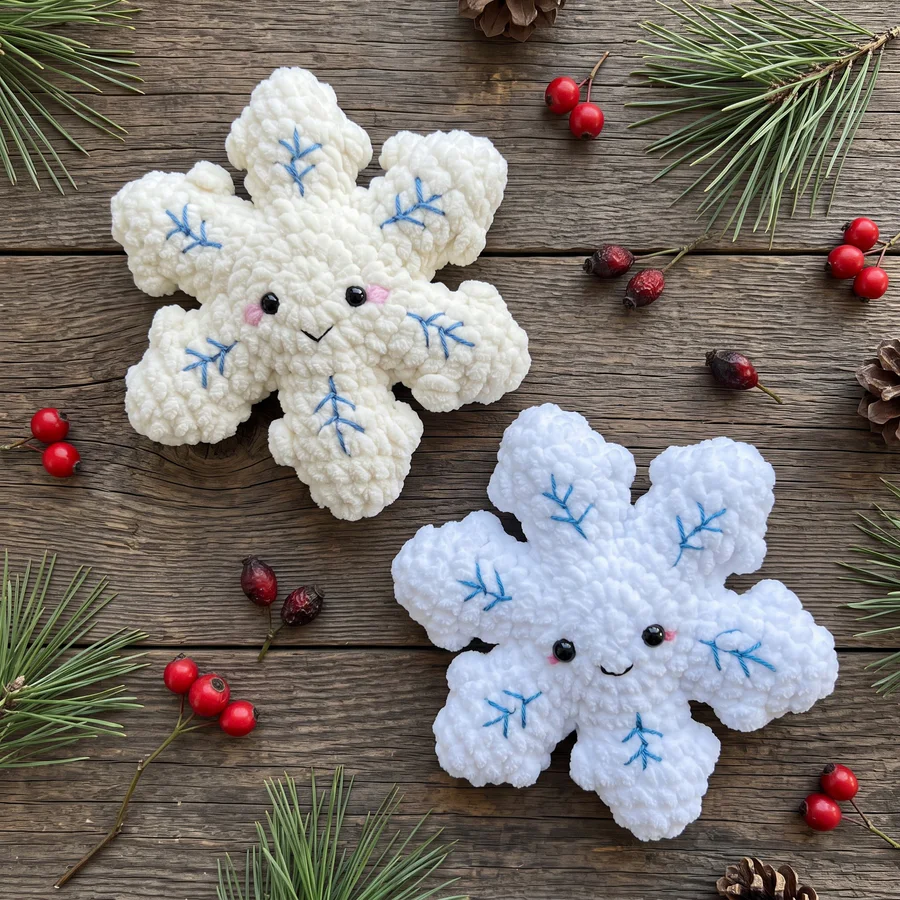
The six-point silhouette works as table décor as well as a hanging ornament. Photo supplied for this article; pattern design by RNata.
Size and display ideas
At roughly 16–17 cm high, the finished snowflake is larger and softer than a flat thread-crochet motif. It can sit in a festive arrangement, top a wrapped gift, hang from a sturdy tree branch, or become part of a winter garland. The face makes it read as a character, while the blue embroidery keeps the snowflake idea clear.
The hand-held photo is especially useful for judging scale. It is still only a visual reference: your yarn, hook, tension, and stuffing will determine the actual result. If you intend to hang the snowflake, plan the loop before closing the work and follow the designer’s finishing sequence. Choose a hanging cord that can support the stuffed piece and inspect the attachment before every season.
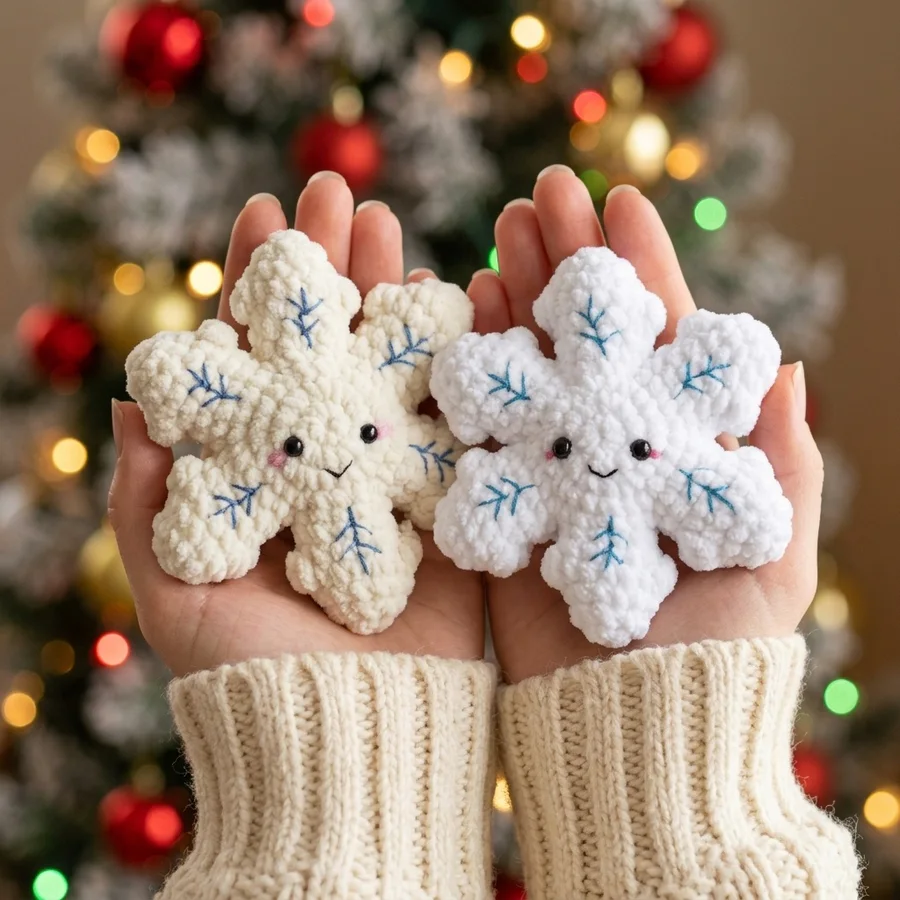
A hand-held view gives a practical sense of the listed 16–17 cm finished height. Photo supplied for this article; pattern design by RNata.
Is this pattern a good fit for you?
This pattern is a promising match if you:
- like quick seasonal amigurumi with minimal assembly;
- already know how to identify stitches in fuzzy yarn;
- are comfortable counting repeated sections and stuffing evenly;
- want a decoration that can work on a tree, gift, shelf, or garland; and
- can follow an English-only PDF without translated terminology.
Pause before purchasing if you need a video tutorial, another language, a printed pattern, or detailed accessibility information. The public listing promises a detailed description, many step-by-step photos, and a materials list, but it does not expose the full page count, crochet terminology, skill rating, or every technique on the sales page. Ask the seller to confirm any point that will decide whether the instructions work for you.
Safety and finishing choices
The photographed face uses 9 mm safety eyes. Despite the name, plastic safety eyes can become a small-part hazard if they detach. A display ornament and an item intended for a young child or pet are different use cases. For a child-facing project, ask the designer whether embroidered eyes can be substituted without disrupting the construction, and check the toy-safety requirements that apply where the item will be used or sold.
Keep hanging loops, stuffing, and decorations secure. Do not place a soft ornament near candles, hot bulbs, or other heat sources. If you plan to sell finished snowflakes, do not assume the purchase includes commercial permission: the listing states that the pattern itself is for personal use. Ask RNata for written clarification about finished-item sales and follow the applicable labelling and product-safety rules in your market.
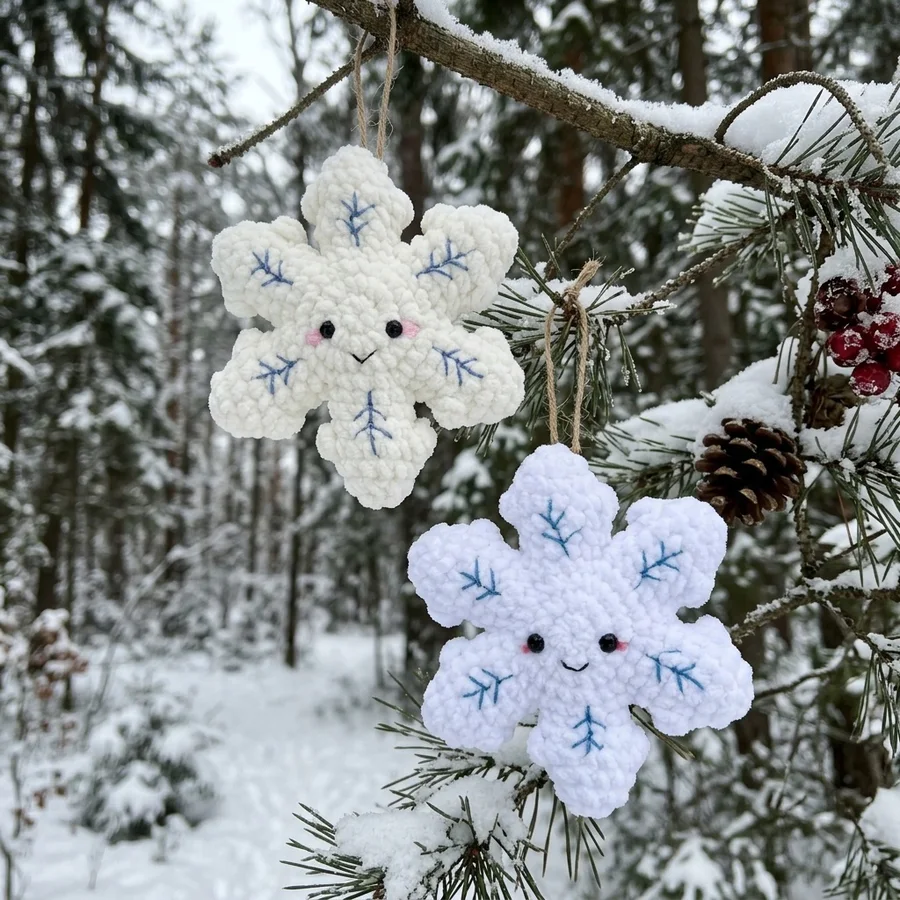
The hanging version turns the plush character into a soft winter ornament. Photo supplied for this article; pattern design by RNata.
What the marketplace signals tell us
When checked on September 26, 2026, Etsy labelled the listing a Bestseller and showed it in more than 20 baskets, with 1,787 favourites. The item displayed a 4.9 average from 50 reviews and a 97% buyer-recommendation figure. Those are useful signs of current interest, but they are snapshots—not guarantees that the instructions will suit every maker.
The RNata shop was shown with a 4.9 shop rating, about 13.6 thousand reviews, 130.7 thousand sales, and 10 years on Etsy. Read the newest item-specific reviews for comments about clarity and ease, then weigh them against your own experience with plush yarn. Review counts, badges, favourites, basket activity, price, and sale status can change at any time.
Our verdict
The strongest idea in this pattern is the combination of a recognisable six-point snowflake and low-assembly construction. The result feels more substantial than a flat motif but stays compact enough for seasonal batches and gift decorating. The embroidered branches also create room for colour variation without changing the core structure.
Choose it for the soft character style and connected construction—not because “no-sew” sounds effortless. You will still need accurate counting, controlled stuffing, embroidery, and careful finishing. If those techniques suit you, this could be a charming repeatable make for a winter collection.
Visit the current RNata Etsy listing for the PDF, current terms, and seller support. Looped Love is not affiliated with Etsy or RNata, and this article does not reproduce the paid instructions.